
San Diego County
Roof Leak Repair & Emergency Tarping
Leak found and stopped, usually same day.
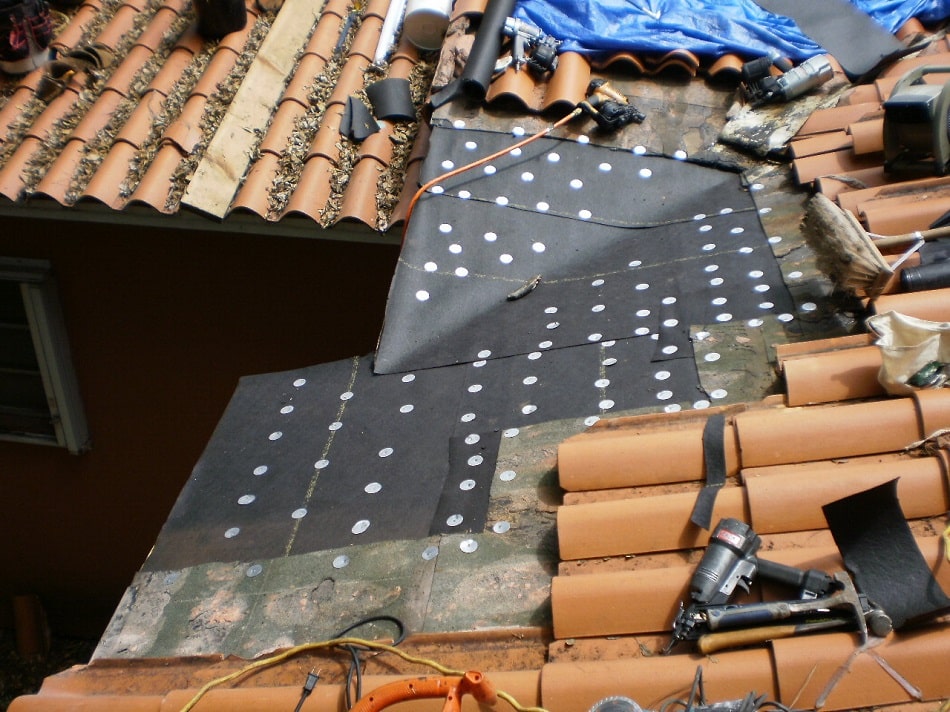
We trace the water back to its real entry point — cracked mortar, a failed pipe boot, a nail pop, a bad wall transition — patch it properly and document what we found. If a storm has the roof open, we tarp it the same day and come back for the permanent fix.
- Leak detection with hose testing and attic inspection
- Same-day emergency tarping and dry-in
- Pipe boot, vent collar and flashing replacement
- Ceiling-stain diagnosis before drywall repairs
The short answer
A roof leak repair in San Diego County typically costs $1,200–$3,000, emergency tarping runs $300–$600, and the inspection is free. We are usually on the roof the same day or the next day, and most leaks are diagnosed and permanently repaired in a single visit. From coastal Carlsbad and Encinitas to inland Escondido and East County, the job is the same: find where water actually enters, fix that, and prove it with photos.
Where San Diego County roofs really leak
Almost no leak we chase starts in the middle of an open roof field. Water gets in at the interruptions — pipe boots, vent collars, skylight curbs, chimney and wall transitions, valley metal, and the low tile course above a patio cover. Those details are made of thin metal, plastic and sealant, and they age two to three times faster than the tile or shingle around them.
On the coast — Carlsbad, Oceanside, Encinitas, Del Mar, Solana Beach, Coronado, Imperial Beach — salt-laden marine air corrodes galvanized flashing and fasteners from the edges in, and the overnight marine layer keeps north-facing slopes damp long enough for moss to hold water in the valleys. Inland, in Escondido, San Marcos, Poway, Ramona and East County, the problem is thermal movement: 40-degree daily swings expand and contract every joint until old mastic cracks and nail heads back out.
That is also why nearly every leak call in the county lands in the first two or three real rains of the season. Nothing broke that week. The gap has been there since summer, and October's first inch of rain is simply the first water to find it.
How we trace a leak instead of guessing
Water travels. A stain over the living room can start eight or ten feet uphill and run down a rafter or along the underside of the underlayment before it drops. So we start inside where we can: attic access, a moisture read on the framing, and a look at the direction of the staining, which tells us where uphill to search.
On the roof we work the suspects in order — penetrations, transitions, valleys, then the field — and where the entry point is not obvious we hose test in stages, wetting one zone at a time from the bottom up while someone watches inside. It is slower than sealing whatever looks worst, and it is the only way to know you fixed the actual leak rather than an unrelated blemish next to it.
Once we know the cause, you get a written quote with photos of the failure before anything is torn into. If the roof is open and rain is coming, we tarp and dry-in the same day and return for the permanent repair once the deck dries out — a wet deck will not take a proper repair.
What a permanent repair looks like
A real repair goes back to layers, not sealant. We lift the finish material around the failure, cut out and replace the compromised underlayment with a proper shingle-lap into the existing courses, re-form or replace the metal, then re-set tile or shingle so water sheds over the patch instead of into it. Rotted sheathing gets cut out and replaced, not painted over.
Sealant has exactly one legitimate job on a roof: sealing a fastener or a joint that is already shedding water by design. Anywhere it is used as the waterproofing itself, it buys a season or two and then leaks again, usually into a bigger repair. If a previous patch was done that way, we tell you plainly what it will cost to do it properly.
Repair or replace — the honest line
Repair is the right answer when the roof material still has service life and the failure is local: one or two leak points, sound decking, underlayment that is aged but intact away from the repair. That describes most of the calls we take, and it is why repairs are all we do.
Replacement becomes the cheaper option when the underlayment has failed broadly rather than at a point — widespread brittleness, multiple unrelated leaks in one season, soft spots underfoot in several places, or a tile roof whose 20–30 year felt has simply run out even though the tile looks fine. When we see that, we show you the photos and say so rather than selling you a fourth patch.
What moves the price
- Access and pitch
- Steep or two-story sections need more staging and a second set of hands.
- What is under the leak
- Dry rot in the sheathing or a saturated area of underlayment enlarges the repair.
- Material matching
- Discontinued tile or a specific shingle color can mean sourcing time.
- Emergency work
- Tarping is billed as its own $300–$600 job when the roof cannot wait for dry weather.
Where we do this work
We are based in Carlsbad and repair leaks across the whole county — coastal North County in Carlsbad, Encinitas, Oceanside, Del Mar and Solana Beach, inland in Escondido, San Marcos, Vista, Poway and Rancho Bernardo, the city of San Diego, East County and the South Bay.
Read more on this
Other repairs we handle
Straight answers
Roof Leak Repair & Emergency Tarping: common questions
- How much does a roof leak repair cost in San Diego County?
- Most repairs land between $1,200 and $3,000 depending on size, access and what we find once the area is opened. Emergency tarping is $300–$600. Inspections and written quotes are free.
- How fast can you get to a leak in Carlsbad or Encinitas?
- Usually same day or next day. Carlsbad is our home base and Encinitas is minutes away, so coastal North County calls are typically on the schedule within a day.
- Can you fix a leak while it is still raining?
- We can stop the water with a tarp and dry-in immediately, and we do that year-round. The permanent repair waits until the deck is dry, because underlayment and flashing will not bond to a wet surface.
- My ceiling is stained but the roof looks fine — is it still a roof leak?
- Often yes. Water enters at a flashing or boot and travels along framing before it shows up. It can also be condensation or a plumbing vent. The free inspection includes the attic so we can tell you which it is.
- Will homeowners insurance pay for it?
- Sudden storm damage is frequently covered; slow wear and deferred maintenance generally is not. Our photo report documents the cause and date, which is what an adjuster asks for.
Where we work
Pick your city
Get your roof looked at
Tell Spot what is going on and we will come out, find the actual leak, and send you a written quote with photos. Active leak? Call — that jumps the line.
(760) 334-4498Mon–Sat 7:00am–6:00pm · Emergency leaks answered 24/7
Based in Carlsbad, CA · We come to you anywhere in San Diego County